Invisible Text for Facebook: Name, Bio & Comments
Invisible Text for Facebook
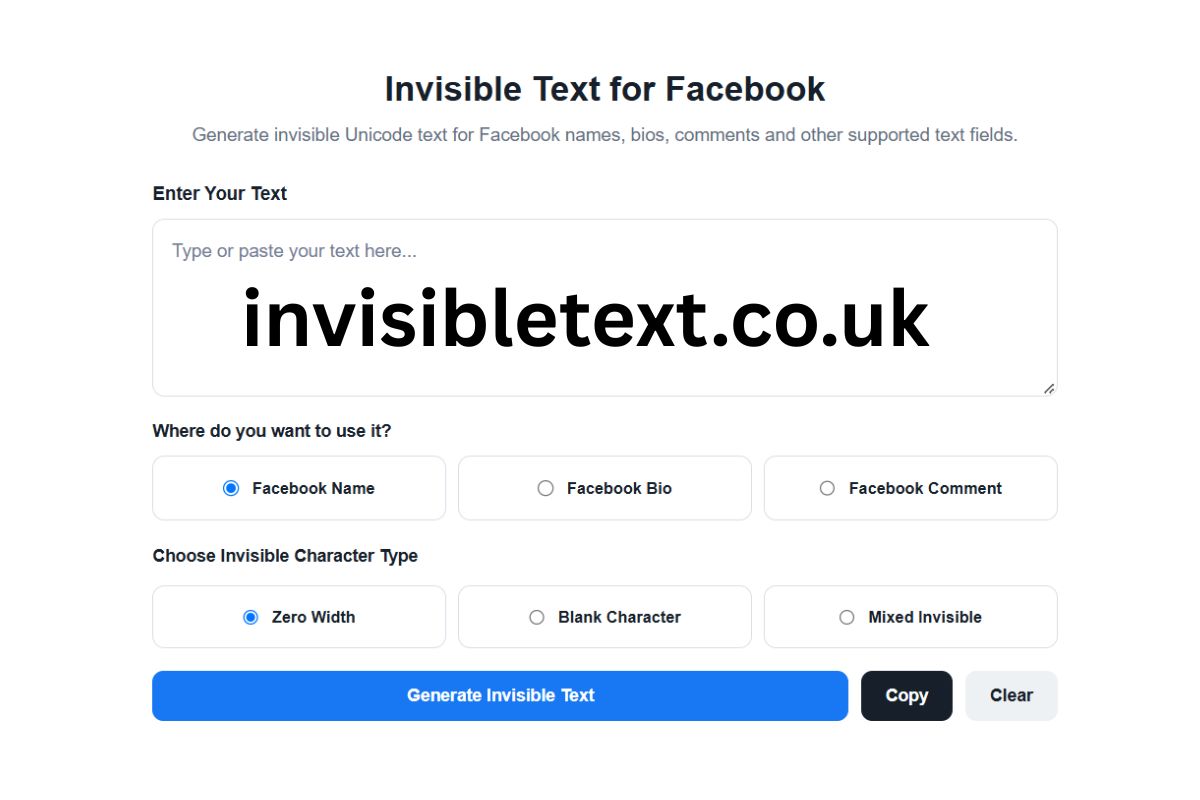
Generate invisible Unicode text for Facebook names, bios, comments and other supported text fields.
How to Use the Facebook Invisible Text Generator
Enter your text, choose whether you want to use the result for a Facebook name, bio, or comment, select an invisible character type, and click Generate. Use the Copy button to copy the generated Unicode characters and paste them into a supported Facebook text field.
Looking for invisible text for Facebook? Our free online Invisible Text for Facebook tool lets you generate invisible Unicode characters that you can copy and test in supported Facebook text fields, including names, bios, and comments.
Invisible text is created using special Unicode characters that may appear blank or have little to no visible representation. Although these characters may look empty, they are still part of the underlying text.
With the tool above, you can generate different types of invisible Unicode characters, copy the result with one click, and test it wherever Facebook accepts the relevant characters.
What Is Invisible Text for Facebook?
Invisible text for Facebook refers to text containing Unicode characters that may not display a visible symbol.
A normal letter, number, or punctuation mark has an obvious visual representation. Invisible Unicode characters are different because some of them have zero width or may be rendered without a visible glyph.
This can make a text string appear empty even though it technically contains characters.
Our Facebook invisible text generator makes it easier to create these characters without manually searching for Unicode codes.
You can choose a use case such as Facebook Name, Facebook Bio, or Facebook Comment, select an invisible character style, generate the result, and copy it.
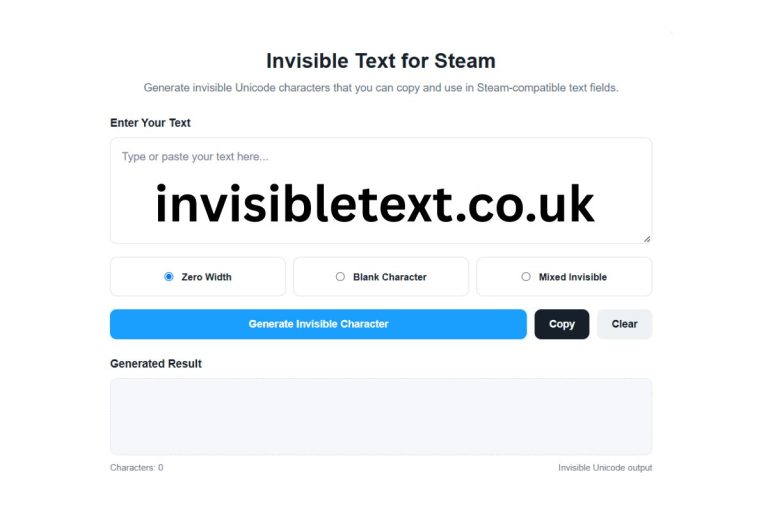
Also Check:- Invisible Text for Steam | Blank Name and Chat Guide
How to Use the Invisible Text for Facebook Generator
Using the tool is simple and does not require technical knowledge.
Step 1: Enter Your Text
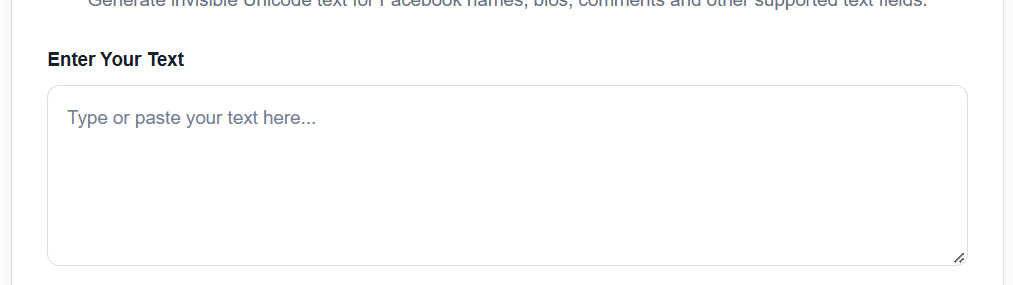
Start by typing or pasting text into the input box.
Your input is used by the generator to determine how many invisible Unicode characters to create.
Step 2: Select Where You Want to Use the Text
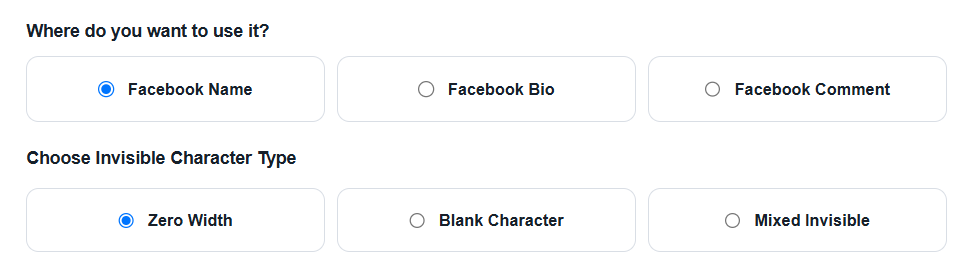
The tool provides three options:
Facebook Name:
Select this option when you want to experiment with invisible Unicode characters in a Facebook name field.
Facebook Bio:
Choose this option when testing invisible characters in a Facebook bio or profile description.
Facebook Comment:
Use this option when you want to generate invisible Unicode text for testing in comments or other supported text areas.
These options mainly organize the tool around different use cases. They do not bypass Facebook's validation or restrictions.
Step 3: Select an Invisible Character

You can choose from different character styles:
Zero Width:
Generates zero-width Unicode characters that normally do not occupy visible horizontal space.
Blank Character:
Creates invisible Unicode characters that may appear blank when displayed.
Mixed Invisible:
Combines several invisible Unicode characters to create a mixed output.
Step 4: Generate the Text

Click Generate Invisible Text.
The tool processes the input directly in your browser and creates the invisible Unicode result.
Step 5: Copy the Result

Click Copy to copy the generated characters.
You can then paste the result into the appropriate Facebook field and check how Facebook handles it.
Invisible Text for Facebook Name
Some users search specifically for an invisible character for Facebook name because they want to understand how Facebook handles Unicode characters in profile-name fields.
It is important to remember that Facebook controls which characters are accepted in names. A generated invisible character is not guaranteed to be accepted.
If Facebook rejects the character, removes it, or changes the result after you paste it, that is determined by Facebook's own validation and text-processing systems.
The tool is useful for generating and testing Unicode characters, but it cannot change Facebook's name requirements.
Invisible Text for Facebook Bio
A Facebook bio is another place where users may want to experiment with invisible Unicode characters.
An invisible Unicode character can sometimes appear blank while still being present in the underlying text.
However, Facebook may process the character before displaying or saving the bio. It may remove unsupported characters, normalize them, or handle them differently depending on the current platform behavior.
If you want to test an invisible character in your Facebook bio, generate it with the tool, copy it, paste it into the relevant field, and verify the result.
Also Check:- Invisible Text for X – Generate Invisible Text Online
Invisible Text for Facebook Comments
Invisible characters can also be tested in Facebook comments and other text fields that accept Unicode.
The behavior can vary between Facebook's website, mobile application, browser, and operating system.
A character that appears invisible in one environment may behave differently in another. Always check the final result after pasting your generated text.
Different Unicode characters may be handled differently depending on the Facebook interface and the device being used. Some characters may remain invisible, while others may be removed, normalized, displayed differently, or rejected.
Invisible Character vs Normal Space
An invisible Unicode character is not necessarily the same thing as a normal space.
A standard space is designed to separate words and create visible spacing in text layout.
Invisible Unicode characters have different Unicode definitions and can have different technical behaviors.
For example, a Zero Width Space normally does not create the same visible gap as an ordinary space.
Other Unicode characters may affect text joining, word boundaries, or rendering.
This is why "invisible character" is a broad term rather than the name of one specific character.
Is Invisible Text Really Empty?
No.
Invisible text can look empty while still containing one or more Unicode characters.
This distinction is important.
An empty string contains zero characters. An invisible string can contain characters that simply do not have an obvious visible representation.
Software can still potentially detect, count, store, copy, or process these characters.
Therefore, invisible does not mean undetectable.
What Is Unicode?
Unicode is a global standard used to represent text and symbols in digital systems.
It includes characters for many languages as well as punctuation, symbols, formatting characters, joining characters, and other special characters.
Some Unicode characters have little or no visible representation.
Examples related to invisible or zero-width behavior include:
- Zero Width Space
- Zero Width Non-Joiner
- Zero Width Joiner
- Word Joiner
- Invisible Separator
These characters are not interchangeable. Each has its own technical properties and intended behavior.
Does Invisible Text Work on Facebook?
There is no universal guarantee that every invisible Unicode character will work in every Facebook field.
Facebook may validate, normalize, remove, or reject certain characters.
The behavior can also depend on the specific field, Facebook interface, browser, operating system, and current platform rules.
If a generated character does not work, try another supported character type and test it again.
The tool does not modify Facebook and does not bypass Facebook's rules. It simply generates Unicode characters that you can copy and test.
Can Invisible Characters Be Detected?
Yes.
The word "invisible" describes how a character appears visually. It does not mean that the character is technically hidden from software.
Applications can inspect the underlying Unicode string and determine which characters are present.
Invisible characters can therefore be detected by text-processing software, validators, scripts, or other systems.
Can I Use Invisible Text on Other Platforms?
Potentially, yes.
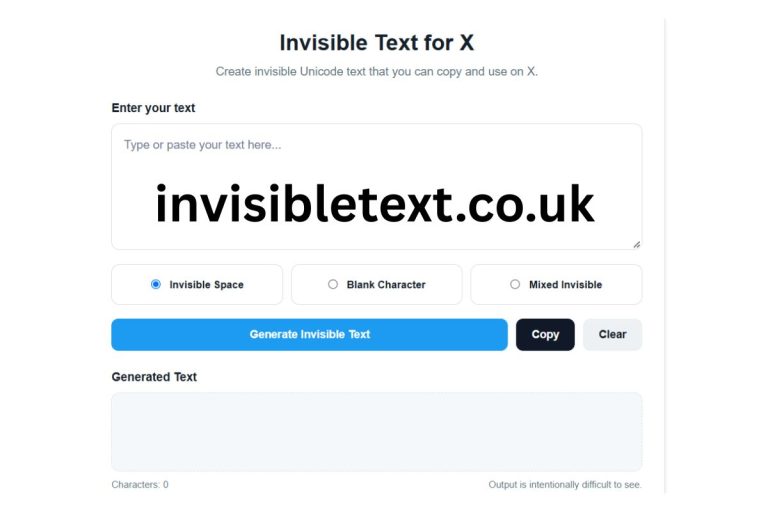
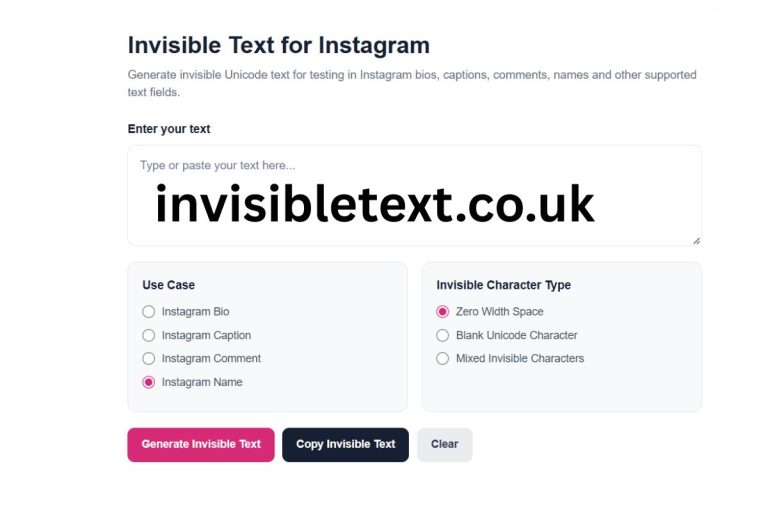
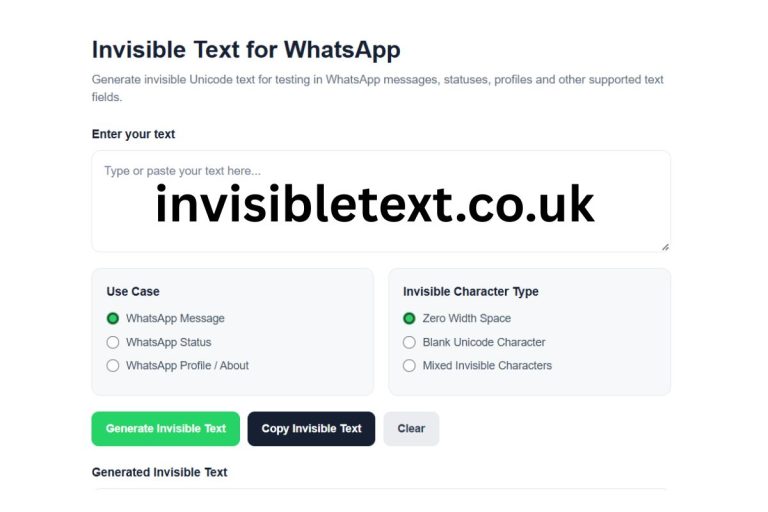
Invisible Unicode characters are not exclusive to Facebook. They may work in other websites, messaging applications, games, social networks, and software that accepts Unicode text.
However, compatibility varies.
A platform may:
- Accept the character
- Remove it
- Normalize it
- Reject it
- Count it toward a character limit
- Display it differently
Always test the character on the platform where you intend to use it.
Is the Facebook Invisible Text Generator Free?
Yes. The tool is designed as a free online utility.
You do not need to install an application, browser extension, or additional software.
Simply enter your text, select a Facebook use case, choose an invisible-character style, generate the result, and copy it.
The generator is designed to make working with invisible Unicode characters faster and easier.
Important Things to Know
Invisible characters should be used responsibly.
An invisible character can still be detected by software even when it cannot be easily seen by a person.
Do not use invisible Unicode characters to impersonate another person, deceive users, bypass security systems, evade moderation, or violate Facebook's rules.
The purpose of this tool is to help users generate and understand invisible Unicode text.
Frequently Asked Questions
What is invisible text on Facebook?
Invisible text is text containing Unicode characters that may appear blank or have no obvious visible representation when displayed.
How do I create invisible text for Facebook?
Use the generator above, enter your text, choose a use case and character type, click Generate Invisible Text, and then click Copy.
Can I use invisible text in a Facebook name?
The generated Unicode characters can be tested in supported Facebook fields, but Facebook determines which characters are accepted in profile names. Acceptance is not guaranteed.
Can I use invisible text in a Facebook bio?
You can test invisible Unicode characters in a Facebook bio if the field accepts them. Facebook may process or remove unsupported characters.
Can invisible characters be used in Facebook comments?
They may work in some text fields, but Facebook can handle different Unicode characters differently. Always test the result before relying on it.
Is invisible text the same as a blank space?
No. An invisible Unicode character and a standard space are different characters and can behave differently.
Can Facebook detect invisible characters?
Invisible characters can technically be detected because they are still part of the underlying Unicode text.
Is the Invisible Text for Facebook tool free?
Yes. The online generator is free to use and does not require additional software.
Conclusion
The Invisible Text for Facebook Generator provides a convenient way to generate and copy invisible Unicode characters for testing in Facebook names, bios, comments, and other supported text fields.
Instead of manually searching for special Unicode characters, you can use the tool above to generate different invisible-character types and copy them with one click.
Keep in mind that invisible characters are still real Unicode characters. They may appear blank to a person but can be processed or detected by Facebook and other software.
Because Facebook's text rules and Unicode handling can change, no particular invisible character should be considered guaranteed to work in every Facebook field.
Generate your invisible text above, copy the result, paste it into the intended Facebook field, and verify how it behaves.